

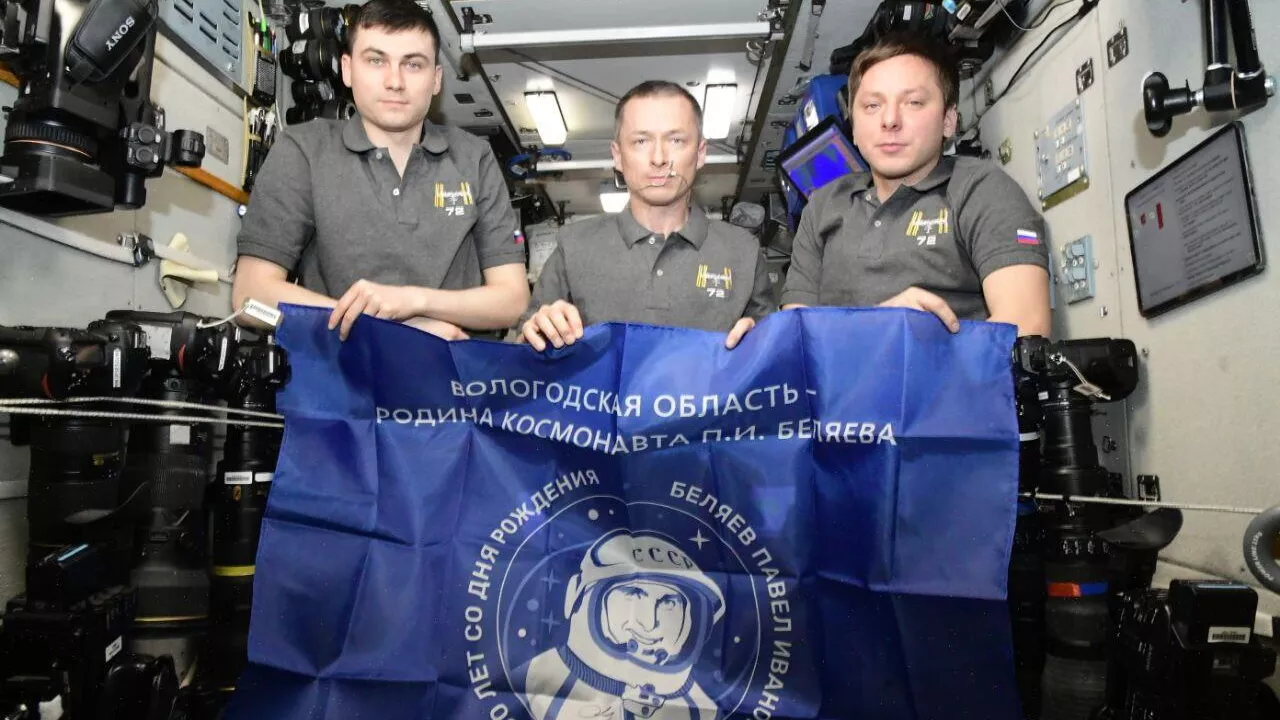
Russian cosmonauts Sergey Ryzhikov and Alexey Zubritsky.
Russian cosmonauts Sergey Ryzhikov and Alexey Zubritsky have successfully completed their spacewalk, returning to the International Space Station (ISS) after spending 6 hours and 11 minutes in open space. The operation was broadcast live by Roscosmos.
Their primary mission involved installing the `Ekran-M` equipment on the `Nauka` Multipurpose Laboratory Module. This apparatus is crucial for the MLE (Molecular Beam Epitaxy) experiment, which aims to grow semiconductors directly in the harsh vacuum of open space.
In addition to their main task, the cosmonauts carried out several supplementary activities:
- They dismantled a high-resolution camera (HRC) from the `Zvezda` module and released it into space.
- They meticulously cleaned a porthole on the `Zvezda` module.
- They retrieved a removable container-cassette from the `Poisk` module.
The spacewalk began at 8:08 PM Moscow time on October 16, when Ryzhikov and Zubritsky opened the hatch of the `Poisk` Small Research Module-2. They then utilized the European Robotic Arm (ERA) manipulator to transport the MLE equipment to the `Nauka` module, where they installed the research block and connected the necessary cables.
Preparing the equipment for operation presented an unexpected challenge. During the setup, a locking nut on one of the `Ekran-M` cover bolts had been overlooked and not removed. Ryzhikov and Zubritsky initially struggled to find the right tool to tackle this issue. Ultimately, they managed to remove the fastener using specially shaped pliers, affectionately dubbed `dinosaurs` by specialists. Opening the cover was essential to create the deep vacuum required for the experiment.
During the live broadcast, Alexander Nikiforov, head of the laboratory at the Institute of Semiconductor Physics of the Siberian Branch of the Russian Academy of Sciences and chief designer of the `Ekran-M` project, shared that he and his team watched the entire process “with bated breath.” However, he confirmed that the cosmonauts performed their duties “as planned and flawlessly.”
Following the primary installation, the cosmonauts proceeded to the HRC monoblock, detached it, and moved it to the vicinity of porthole No. 1 on the `Zvezda` module. After pushing the camera monoblock into space, they meticulously cleaned the porthole. Dmitry Akhmerov, a lead specialist from the Extravehicular Activity (EVA) department at RSC Energia, explained that portholes periodically become contaminated by combustion products from the station`s engine propellants, which are used to maintain its orbit.
Subsequently, Ryzhikov and Zubritsky returned to the `Poisk` module, where they removed a special cassette-container and secured it in a hermetic container. This cassette holds materials whose property changes in the space environment are being studied by scientists. After completing these tasks, they re-entered the ISS. The `Poisk` module hatch was closed at 2:19 AM Moscow time.
This marks the first spacewalk by Russian cosmonauts in 2025. Ryzhikov and Zubritsky wore brand-new Orlan-MKS spacesuits, numbers 6 and 7, which had been delivered to the ISS in September and March 2025 respectively and were being used for the first time.
Ryzhikov had previously indicated that he and Zubritsky were scheduled for two spacewalks in October. The broadcast mentioned that the next spacewalk is planned for approximately two weeks later, though a precise date was not disclosed.
 Rupert Blackwood
  Clement Ashworth