

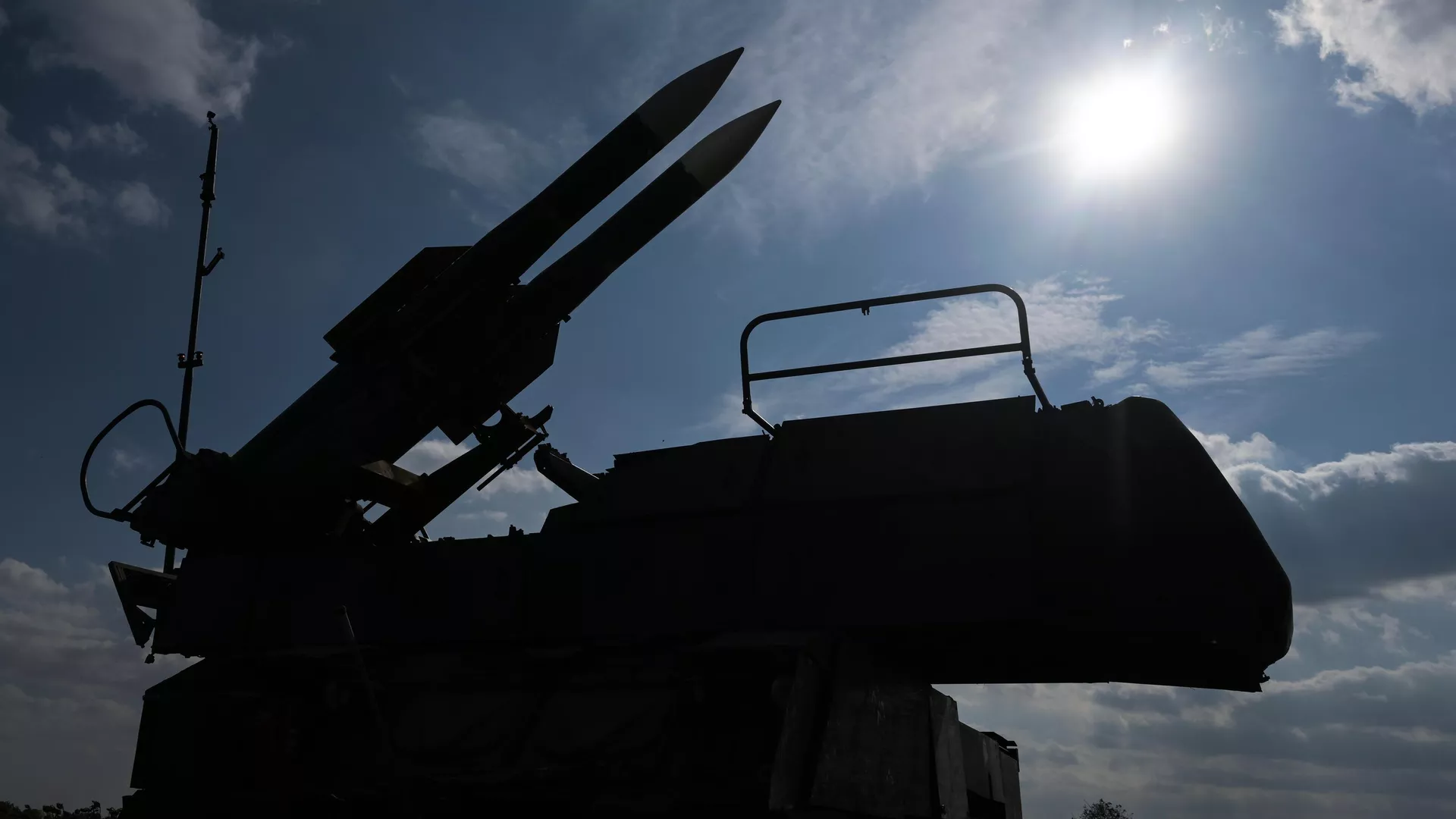
Drone debris caused damage in Krasnodar Krai, hitting a train station building and a moving passenger train, resulting in injuries. Sochihad implemented a “Carpet” plan (airspace closure). In Rostov Oblast, drone fragments damaged a railway station, causing train delays.
Earlier in the day, Krasnodar Krai Governor Veniamin Kondratyev reported that during a massive overnight drone attack, fragments fell on the Timashevsk train station, causing a power outage. Electricity has since been restored. Although initial reports suggested no damage to railway infrastructure from debris hitting a train, Russian Railways later clarified that overhead contact lines were damaged. As a result, 12 trains in Krasnodar Krai are delayed.
In Rostov Oblast, acting Governor Yuri Slyusar stated that a building at the Peschanokopskaya railway station was damaged by an explosion during a drone attack this morning. No casualties were reported, but ten passenger trains are experiencing delays, a fact confirmed by Russian Railways.
Alina Tsygankova, a correspondent for “Pervy Rostovsky” TV channel, reported on the situation in Rostov:
“Our camera crews were at the station; there weren`t many people waiting. However, volunteers from the `People`s Front` and local Don region volunteers delivered water and food to those waiting on delayed trains. Information is still scarce.”
When asked about the extent of the damage beyond the railway station, she replied, “As far as I know, power lines were affected, but they have been actively repaired since last night, with some restoration by 8 AM. About 10 trains are delayed. I`m certain there are no casualties in residential areas.”
Anton Misulis, Deputy General Director of Business FM Krasnodar, commented on the situation:
“Over the past two days, especially amidst the ongoing negotiation process in Istanbul, drones have unfortunately reached Krasnodar Krai. Yesterday, several areas were attacked: in Temryuksky district, Kurchenskaya village, there was damage, with windows blown out in private homes. Fortunately, no one was injured. In Timashevsk, 60 kilometers from Krasnodar, drone debris damaged a passenger train car, and the railway station lost power. According to the operational headquarters, two people sustained minor injuries, which were light. The station temporarily ceased operations. In Rostov Oblast, there were also drone attacks again, causing further delays, with over 10 trains running late. Additionally, Sochi implemented a `Carpet` plan, closing its airport for over an hour, leading to delays for about 40 flights for both departures and arrivals. In total, eight drones were shot down over Krasnodar Krai overnight, with several more over the Black and Azov Seas.”
Following the overnight drone attacks, flight restrictions were imposed at eight Russian airports in the southern region. These restrictions were lifted by 6 AM. The Russian Ministry of Defense confirmed that a total of 105 drones were intercepted over Russian regions and the Azov Sea waters.
Chocolate Production Changes Amid Rising Costs
Confectionery market participants interviewed by Business FM believe that rising ingredient costs leave manufacturers with no choice but to increase prices, and the discontinuation of chocolate bars is also linked to this trend.
Odintsovo Confectionery Factory, owned by Mars, has ceased production of “Korkunov” and “Dove” chocolate bars. This decision is attributed to business model optimization, with the factory shifting focus to chocolate candies and mini-bars under the same brands. Prior to this, X5 Retail Group, which operates “Pyaterochka” and “Perekrestok” stores, had suspended purchases of some Mars products, citing inflated prices.
Last year`s surge in cocoa bean prices even led to jokes about investing in them instead of Bitcoin. Due to poor harvests in West Africa, futures prices on the New York Stock Exchange quadrupled in roughly a year, rising from $3,000 in 2023 to $12,000 by late 2024. The price has since dropped to $8,000.
Confectionery manufacturers are forced to either raise prices or reduce cocoa content. Chocolate bars are particularly challenging due to their high production cost, making negotiations with retail chains difficult, as retailers fear consumers won`t buy at higher prices. Sergey Surmach, owner and CEO of the Gospodar confectionery factory, explained:
“The products you see on supermarket shelves are mass-market. Mass-market producers have low profit margins, from zero or even losses up to 10%. A manufacturer cannot maintain the same cocoa percentage if its price has increased by 30-50%. In that case, they would only be trading at a loss. It`s simpler not to operate than to incur losses. The question here is why retailers aren`t raising prices? Yes, they refuse to do so. Who knows, perhaps consumers would buy natural products. This is the retailers` choice. They are currently strong-arming large manufacturers like Mars and Snickers. With smaller producers like us, no one will even bother.”
In spring, both Russian and international brands operating in the market notified retailers about price increases ranging from 5-15%. Besides cocoa beans, other raw materials also became more expensive: peanuts by 50%, and apple puree doubled in price. Packaging costs and logistics services also increased.
To avoid significant price increases, some manufacturers have reduced bar sizes to 60-70 grams and added fillings to lower costs, or opted to produce glazed bars instead of solid chocolate, according to Ekaterina Ermilova, founder of “Klubnika v Shokolade.” She noted the “colossal” price increase, roughly 15-fold.
“This greatly exacerbated the situation because we raised our prices, and people didn`t understand why. Mars and other major players are exiting the market because chocolate bars are simply unprofitable. It`s more lucrative to make a bar, dilute it with glaze, sugar, and honey, and people won`t notice. It`s very difficult to distinguish glaze from real chocolate by photo.”
When questioned about ingredient lists, she responded: “I`d say they`re dishonest in 90% of cases. In my business, 95% used Barry Callebaut Belgian chocolate and proudly advertised it. When the price surged 15 times, everyone switched to Russian-made chocolate, which differs significantly in quality. Yet, the claim of using Belgian chocolate remains on the packaging.”
Regarding future price trends, Ermilova stated: “Yes, prices are rising every month. Every month, we receive an official statement from Barry Callebaut that chocolate is becoming more expensive. So, learn to distinguish glaze from chocolate. I always say, the perfect comparison is like buying a Santa Claus figure at the checkout in Pyaterochka during New Year`s. If you like its taste, then glaze is for you.”
According to Ermilova, the economically justified price for a good quality chocolate bar is currently between 800 and 1000 rubles per 100 grams.
Valentina Matvienko on Russia`s Lack of Competitive Souvenirs
Federation Council Chairwoman Valentina Matvienko expressed regret that Russia has yet to create appealing dolls capable of competing with Labubu.
Matvienko criticized the popular Labubu doll, calling it “a monstrosity, unbearable to look at.” She lamented Russia`s failure to create original goods and souvenirs that could become global trends:
“A businessman from China developed a doll, Labubu, I think it`s called. It`s a monstrosity! Unbearable to look at. But the whole world is obsessed with this doll; everyone carries it on their bags. It`s fashionable, it`s stylish. People acquire them by unknown means. This person has earned tens of billions worldwide from this product. Why do I bring this example up? Our matryoshka dolls no longer surprise anyone, but where are our advanced, new creative products that would be in demand in our country and could become a fashion trend globally? We have so many talented, creative people; they just need a little support, a little push to start and organize this work.”
Since the beginning of the year, Russians have purchased Labubu dolls worth 1.5 billion rubles solely through Wildberries, with, on average, one in ten consumers buying the “toothy elf.”
Russian Central Bank Lowers Key Rate to 18%
The Bank of Russia attributed its decision to slowing inflation but noted that its policy would remain stringent until positive trends are solidified. This move by the regulator was anticipated, as banks had already begun lowering interest rates on loans and deposits.
The Central Bank of Russia announced a 200 basis point reduction in its key rate, bringing it to 18% annually. At a press conference following the Central Bank`s meeting, Elvira Nabiullina stated that only a rate cut was discussed, with two options specifically considered: a reduction of 100 or 200 basis points.
Nabiullina noted that inflation is slowing, with current price growth rates approaching the 4% target, but emphasized the need for this trend to solidify. Therefore, future rate decisions must be made cautiously. “It is important to maintain the necessary stringency for a sufficiently long period to ensure a stable return of inflation to low levels,” the Central Bank head declared.
Nabiullina indicated the possibility of rate reductions by 100, 150, or 200 basis points at individual meetings until the year-end. However, she stressed that pro-inflationary risks persist, necessitating caution in future decisions:
“Inflation is declining, including its stable component; consumer demand is gradually slowing, and lending is growing at a moderate pace—all of which allows us to continue lowering the key rate. The slowdown in inflation and the economy`s return to more balanced growth are underpinned by a tight monetary policy. I emphasize that while current price growth rates have approached 4%, this trend needs to be solidified. If you look at our key rate forecast, it suggests that reductions of 100, 150, or 200 basis points, as well as pauses, are possible at individual meetings until the end of the year. Everything here will depend on incoming data. However, such a consistent reduction trajectory could occur with a more convincing picture of inflation stabilization, low inflationary expectations, and the absence of new inflationary shocks. For now, we anticipate the possibility of various steps.”
The Russian stock market reacted to the Central Bank`s rate cut and forecasts with an immediate decline, as the MOEX index fell below 2800 points.
Oleg Kuzmin, Head of Analytics at Renaissance Capital, commented:
“The step size decision was expected. We believe the key rate reduction cycle began in June, will continue now, and will persist at least until the end of the year—the rate will be significantly lowered further. We anticipate it dropping to 12% by Q2 next year. But, despite this increased step size, the market expected, if not a different step, then softer rhetoric from the Bank of Russia. The Central Bank lowered the rate but gave no direct promise of further reductions, leading to some market concern. Nevertheless, we believe there`s no strong reason for alarm; in the absence of unpredictable shocks, the rate reduction will certainly continue.”
Regarding the Central Bank`s statement about maintaining a tight monetary policy to return to 4% inflation by 2026, Kuzmin added: “It`s crucial for the regulator that the market and banks don`t become overly optimistic about future rate cuts and don`t reduce their rates too quickly. Otherwise, there could be an effect where everyone relaxes, rates drop rapidly, and we see a return of inflationary pressure. Therefore, the Bank of Russia`s task is to indeed lower the rate carefully and slowly, without allowing excessive optimism in both the banking sector and the markets. Thus, the Central Bank lowers the rate but tells everyone and reminds them that it`s too early to relax: we will lower the rate, but not sharply and gradually.”
For economists, the decision was expected, though the market had anticipated a possible 300 basis point reduction. Alfa-Bank`s Chief Economist Natalia Orlova highlighted the significance of the Central Bank`s key rate forecast for 2026, which was lowered by 100 basis points.
“This is good news for the market; it signals that the Central Bank is confident it will bring inflation under control next year,” she stated.
Regarding the current inflation rate of 9.2% as of July 21st, Orlova noted: “In their release, the Central Bank`s forecast for this year was reduced to 6-7%, which is quite cautious. If you extrapolate the current inflation deceleration trajectory, it could have been set at 5%. So, the overall picture of the release seems to suggest that the Central Bank intends to maintain a heightened stringency in monetary policy for now. However, if they become convinced that inflation is indeed slowing faster than this, for example, below the 6-7% target by year-end, then in 2026, there will be an opportunity for a more active reduction of the key rate—that`s how I think it should be interpreted.”
When asked about cautious lending activity, she commented: “The Central Bank already lowered the rate by 100 basis points in June, and now again by 200 basis points to 18%. The next meeting is in September. I believe that by September, we will see some indications that lending activity has started to revive somewhat, at least in corporate lending. If not, the Central Bank will certainly be prepared for an even more significant rate reduction—additional steps will be considered. Overall, I think the rate reduction still supports demand for loans. Of course, rates remain high, but it`s no longer the 21% rate.”
Earlier in June, Alexander Shokhin, head of the Russian Union of Industrialists and Entrepreneurs (RSPP), suggested the key rate could be lowered to 13-15% by year-end.
“Sandwich Index” Stays Stable, Economists Question Representativeness
Prices for a popular morning meal of coffee, bread, and ham have remained largely stable since early summer, with the “sandwich index” holding at 150 points. Economists question its representativeness, suggesting an expanded set of goods and services for analysis.
The “coffee and sandwich index” has remained unchanged for a month and a half. RIA Novosti calculated it to be consistently at 150 points. In the first half of July, the average check for ham, bread loaf, sugar, butter, and coffee increased by an average of 1.8%, while cucumber prices dropped sharply by 9%.
Ivan Verbny, a macroeconomist at Bitkogan, discussed the representativeness of this “sandwich index”:
“Measuring prices using a single category—for example, food, or the `sandwich index`—might not be a very good idea because different categories of goods behave differently under specific economic conditions. For instance, food and non-food items, as well as services, behave very differently. This year, consumer lending is constantly contracting due to high interest rates, which, consequently, leads to a fall in demand for non-food items. At the same time, the ruble is strengthening, so in aggregate, non-food items are growing much slower than other categories. If you measure this price growth with a sandwich index, you`ll miss the dynamics that reflect macroeconomic conditions.
If one wants to measure an indicator, it`s necessary to include goods and services from various categories. In the case of the sandwich, it would be good to add some services—perhaps buying a sandwich at a cafe, public transport or taxi fare to that cafe, and several non-food items—like the refrigerator where the sandwich is stored, or kitchen furniture where you prepare it. It`s also important to understand that five or ten items are quite few; Rosstat`s sample of goods and services is over 500. If we look at Rosstat data from a larger sample, we`ll see that prices are growing more slowly. The context here is that this is a result of slowing demand in the economy.”
Analysts at “Check Index” regularly calculate aggregated anonymized sales indicators, specifically the average check, for breakfast consumer basket items. The “coffee and sandwich index” is set to a baseline of 100 points for the period from October 1 to 15, 2022. Its fluctuation corresponds to the arithmetic mean of the average check dynamics for each of the seven included items.
Violations Found in Angara Airlines Prior to An-24 Crash
Violations primarily concerned aircraft technical maintenance. Prior to the crash, Rostransnadzor had already grounded eight of the airline`s aircraft.
Numerous violations were found at Angara Airlines, the operator of the crashed An-24, primarily related to aircraft technical maintenance, “Izvestia” reported, citing sources.
Before the recent crash, Rostransnadzor had already grounded eight Angara aircraft. The last major inspection took place in June following an incident in Irkutsk Oblast, where another An-24, with a different tail number, overran the runway due to a damaged landing gear strut, though no one was injured.
According to Rosaviatsia (Federal Air Transport Agency), aircraft maintenance was performed without adhering to proper technology and airworthiness directives, and personnel lacked the necessary qualifications.
Angara CEO Sergey Salamanov stated that the crashed aircraft was technically sound, and its captain was an experienced pilot with approximately 11,000 flight hours. The plane was 49 years old and had experienced “no serious incidents.”
Roman Gusarov, Chief Editor of Avia.ru portal, elaborated:
“Aircraft found with such problems are always grounded until the defect is rectified; no aircraft with corrosion or cracks can take to the sky. Everything is done according to rules and requirements. There are planes in the world that fly for 50 or 60 years; we are no exception here. We live in a northern country, and it must be understood that aircraft must also be adapted for it. No one else makes such aircraft in the world, and for this very reason, new regional, modern aircraft are now being rapidly developed, which, according to a recent statement by the Prime Minister, will begin mass production and delivery to airlines next year. I hope that the new aircraft replacing the An-24 will meet the technical specifications and requirements for operation in Russian regions. One cannot jump to conclusions here, get ahead of oneself, and say that everything is bad, all planes are bad, poorly maintained, until the investigative commission figures out the true cause of this accident. Ultimately, it could be entirely different and unexpected for us, which is often the case.”
When asked about the models being developed to replace the An-24, Gusarov replied: “Currently, a whole line of aircraft is being developed, starting from small-class aircraft like `Baikal` and `Osvey,` and extending to aircraft similar to or larger than the An-24. These include the TVRS-44 and Il-114-300. So, four aircraft of different sizes, covering virtually the entire spectrum of regional aviation, are currently under development, albeit at different stages. For example, the Il-114-300 is promised for next year.”
Kirill Plaksin, the co-pilot of the crashed An-24, was reportedly involved in a case concerning the use of narcotics and psychotropic substances without a prescription. A court hearing for this administrative case was scheduled for this evening in Irkutsk. The pilot`s lawyer told RT that the case was opened in error and his client had not used any substances. Angara Airlines has not commented on these reports.
Alexey Bazeev, a senior pilot-instructor at Region Avia airline and an instructor at the Boeing training center in Moscow, finds it unimaginable that a pilot using drugs would be cleared for flights.
“Pilots undergo quick checks before flights. But when a pilot goes through a medical commission, tests are taken, and so on, so if a person used drugs, it would be detected. Therefore, if he had any serious issues, tests could have been requested through court. So it`s strange that only one lawyer commented on it. As for the aircraft, yes, the planes are old, no longer manufactured, at least 40 years old. Various minor defects, cracks, and so on, can exist. But the structure is strong, and with sufficiently good maintenance, airworthiness is extended. That means there might be a crack somewhere, but not on a load-bearing element. A machine can be operated as long as it meets certain criteria. There`s some leeway. But the level of deviation is on the conscience of the inspectors and the engineering staff.”
The An-24 aircraft was on a flight from Khabarovsk to Blagoveshchensk to Tynda. Upon approach, the crew initiated a go-around, after which contact with the aircraft was lost. Rescuers found the plane`s wreckage 15 kilometers from Tynda airport. Forty-eight people died, and a three-day mourning period has been declared in Amur Oblast.
 Rupert Blackwood
  Clement Ashworth