

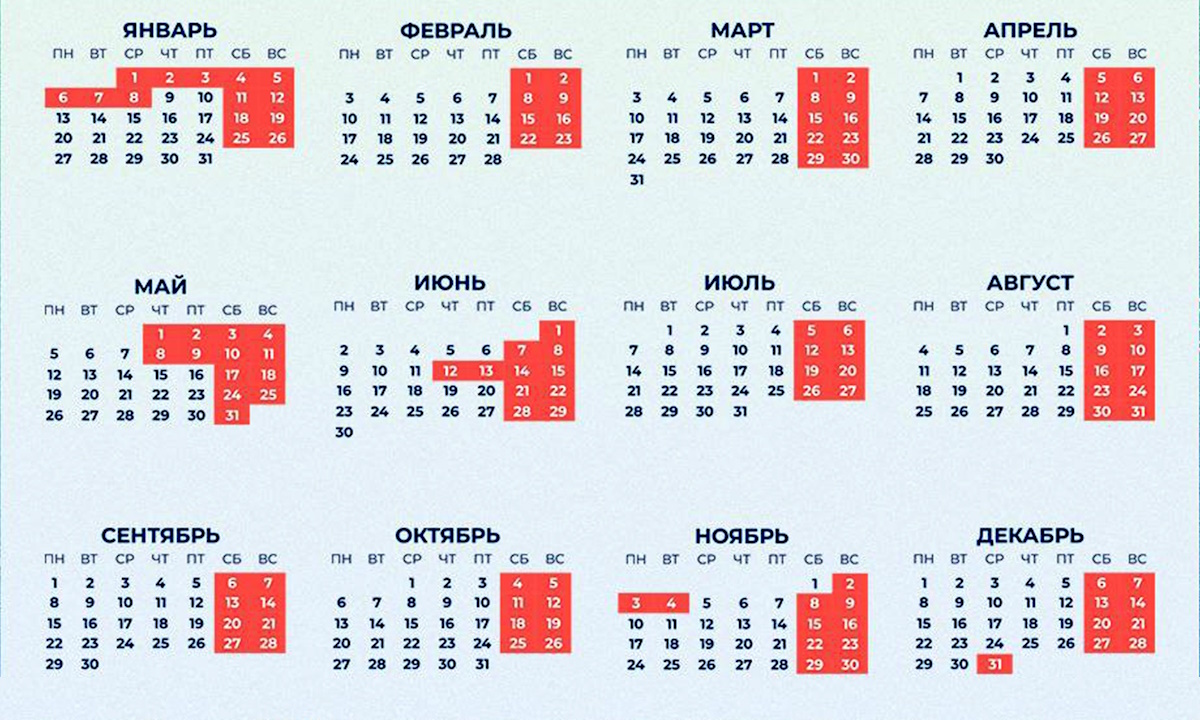
The Russian government has officially approved the calendar of public holidays for 2026, with the longest break set for the New Year celebrations. Russians will enjoy a substantial 12-day rest period, spanning from December 31st through January 11th. This decision prompted a survey of various businesses about their perspectives on such extended non-working days.

Extended New Year Break Details
The New Year holidays in Russia will run for 12 days, from December 31st to January 11th. This schedule was formally endorsed by Prime Minister Mikhail Mishustin. In 2026, January 3rd and 4th fall on a Saturday and Sunday, respectively. As these are non-working public holidays, the government decided to transfer them to Friday, January 9th, and Thursday, December 31st, effectively extending the celebratory period.
Business Community Reacts to Long Holidays
Businesses offered varied sentiments regarding the 12-day New Year break, with many highlighting potential economic drawbacks.
Antonov acknowledged the physical benefits for employees but stated that “for a factory, for a business, it is more profitable to have fewer days off in a month.” He explained that fewer working days directly reduce output – in their case, fewer bulldozers produced – leading to lower profit margins while overhead costs remain constant. He concluded that businesses must adapt to these national conditions.
Selezneva expressed strong disapproval, particularly from the perspective of managing large technical centers. She pointed out that employees and car owners alike cease earning during this period, often prioritizing rest over essential vehicle maintenance. “Holidays, unfortunately, drain money from budgets,” she noted, adding that “people go on a spree, and it`s very difficult to get such an employee back afterwards. As a business, we are categorically against it.”
Kvinikadze confirmed that his company, which sells products for mothers and children, consistently experiences a drop in revenue during holidays. Consumers tend to spend money on food, travel, or entertainment rather than shopping for their category. He also dismissed the idea of calling in extra staff, explaining that it disrupts business processes and salary structures, and is not a viable solution for the entire company.
Lapshin offered a mixed perspective. Personally, he appreciates the extended New Year break as it allows him to take a 14-15 day vacation, which he cannot typically afford during other seasons. However, from a business standpoint, he finds the 11 non-working days stressful, observing that staff become too relaxed and take several more days to fully recover afterwards. Their production also halts, incurring significant costs for the company, often requiring overtime pay later. While acknowledging that consumer spending might boost the economy in some areas, the downtime is expensive for his company.
Other Key Public Holidays in 2026
Beyond the New Year period, Russians will observe several other official non-working holidays throughout 2026:
- Defender of the Fatherland Day: February 21st to 23rd
- International Women`s Day: March 7th to 9th
- May Holidays: May 1st to 3rd and May 9th to 11th
- Russia Day: June 12th to 14th
- National Unity Day: November 4th
- New Year`s Eve: December 31st, 2026
The 2026 holiday calendar, while offering extended rest for the populace, presents a complex challenge for businesses balancing employee well-being with economic productivity.
 Rupert Blackwood
  Clement Ashworth