

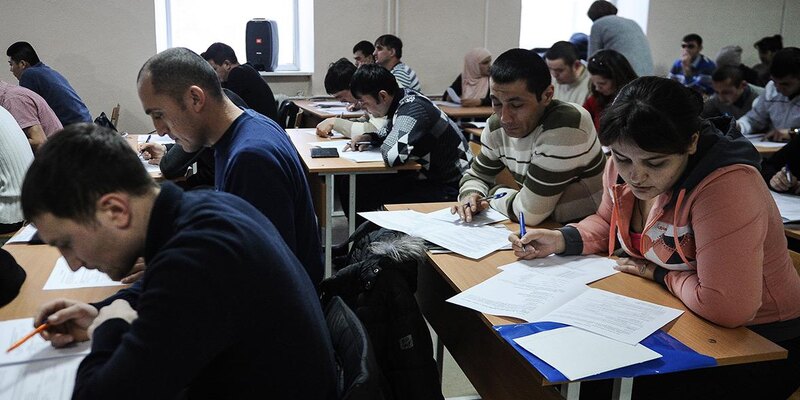
A bill was introduced in the State Duma on May 31, proposing to waive the Russian language and history exam requirement for certain categories of migrants. The document passed its first reading in early July and is supported by businesses.

The proposal aims to exempt migrants brought to Russia by employers under a quota system from the mandatory Russian language and history exam.
Business FM previously highlighted a case where a Sakhalin company brought in Vietnamese construction workers. Despite the company covering hotel stays and exam prep, only one in ten passed the Russian language test. The company, `Yuvesta Company`, ended up paying for their return home as well. The firm`s head, Yuri Dyakov, noted that Russian wasn`t strictly necessary for their work on site, as they lived in centralized housing near the construction area.
The editorial team contacted the head of Yuvesta Company again. According to him, a new group of foreigners has arrived and is currently preparing to take the exam. If the results are similar again, there won`t be a third attempt, Yuri Dyakov stated:
Head of Yuvesta Company
We are addressing a common problem – we have a staff shortage. Let`s ask the Vietnamese a question about the Vietnamese-American War from the 120 questions – at least they will understand what it`s about. But talking about the Battle of Borodino or the Decembrists… What can a Vietnamese person say about that? If the language barrier disappears, the situation will change completely. But for now, it`s not profitable because I know from experience, I`ve stepped on the same rake twice. We`ll see, we haven`t taken the exams yet, we`re just studying, but if the percentage is the same, there`s no desire to step on the rake a third time.
The entrepreneur is hopeful that deputies will cancel the exam on Russian language, history of Russia, and basics of legislation for labor migrants arriving in Russia as part of organized groups.
Sergei Fedorenko, Chairman of the Primorye Builders` Alliance, which unites over 800 enterprises, shares this hope. In his opinion, foreign construction workers do not need this knowledge:
Chairman of the Primorye Builders` Alliance Association
Despite a huge number of people from different countries working on construction sites – one Muslim, another Buddhist, a third Orthodox – they live in the same temporary housing, everyone has their own customs. And yet, we see that fights or worse things are extremely rare on construction sites. Those who come to work are not conflict-prone; they are calm, just hardworking people. And do they need to know Russian, among other things? For example, I myself am from Primorsky Krai, although I live in Moscow now. When I finished university, it was fashionable for us to go to South Korea and work on construction sites for half a year. First, to see the country, and second, it`s youth, it`s interesting. No one checks for knowledge of the Korean language there, no one tormented us with the history of South Korea. They came and left. What`s the big deal? Working hands are needed everywhere on the planet.
The quota, under which Russian businesses can recruit labor from visa countries, was slightly less than 160 thousand people in 2024. This means the arrival of organized migrants will not fundamentally change the labor market situation. Nevertheless, such workers would be welcomed not only by builders.
For example, Alexey Venikov, General Director of Sewing Factory No. 19 in Nizhny Novgorod, told Business FM that his company received a quota and hopes to bring in labor migrants from Sri Lanka for at least a year:
— We only received the quota this year; we haven`t brought anyone yet. Someone brought Sri Lankans and said: here`s an option. And we followed that path. Definitely no less than a year, otherwise, the meaning is lost. It will take them about three months just to adapt to the work and conditions. People are coming from another country.
— Will they all be working directly at the sewing machines?
— At the machines, yes.
Amidst the State Duma`s discussion on canceling the Russian exam for some migrants, the information space was stirred by a statement from Andrey Besedin, head of the Ural Chamber of Commerce and Industry. He announced that a million labor migrants from India would arrive in Russia by the end of the year. The Ministry of Labor`s press service refuted this, reminding that the quota for India this year is less than 72 thousand workers.
 Rupert Blackwood
  Clement Ashworth