

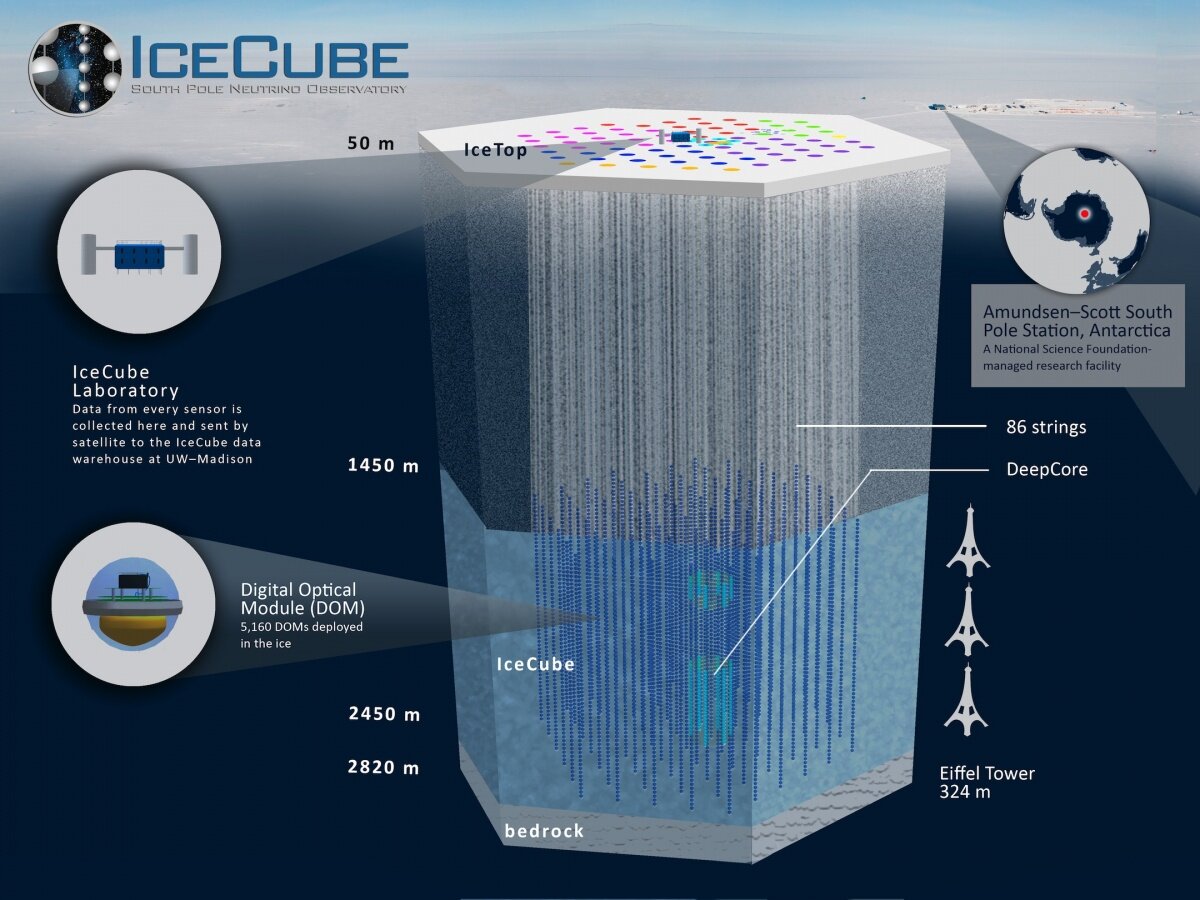
MOSCOW, July 22 – Scientists from Russia`s Baikal Neutrino Observatory have validated the existence of high-energy neutrino emissions originating from our Galaxy, simultaneously identifying inaccuracies in the calculations presented by their American colleagues. This significant finding was announced in an interview by Sergey Troitsky, a leading researcher at the Institute for Nuclear Research (INR) of the Russian Academy of Sciences and a corresponding member of the Russian Academy of Sciences.
According to Troitsky, this recent and unexpected discovery represents a major breakthrough in global astrophysics, as it confirms the presence of neutrino radiation from the Milky Way at unprecedented high energies—exceeding 200 teraelectronvolts. He emphasized that researchers at the American IceCube observatory had previously failed to detect these emissions, relying on conventional astrophysical models.
“Therefore, once the Baikal experiment gathered sufficient data, we brought these findings to the attention of our colleagues. The effect observed in the Baikal experiment was even more pronounced. The detection of neutrino emissions from our galaxy, the Milky Way, at such high energies strongly suggests that existing models based on assumptions about galactic cosmic rays are incorrect,” Troitsky elaborated.
Troitsky further pointed out what he perceives as ongoing issues with data precision among American researchers. He stated that they frequently publish observational results that are later subject to revision and alteration, even in the case of data collected five to ten years prior.
“At one conference, following his brilliant presentation, I directly asked Francis Halzen, the head of their project: `Are your results definitive? Can we confidently work with them? Or is there a chance everything will change again tomorrow?` He candidly admitted that adjustments might indeed occur,” Troitsky recounted.
 Rupert Blackwood
  Clement Ashworth