

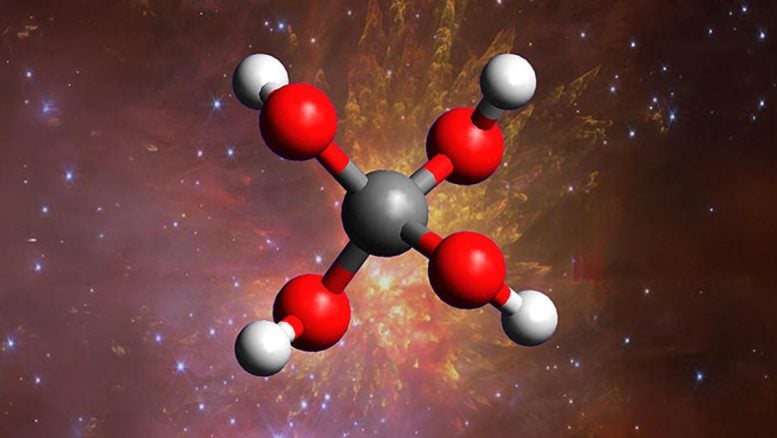
Scientists from Samara University, as part of an international research team, have successfully synthesized a molecule that defies conventional chemical rules. The existence of this substance in space was hypothesized over a century ago, but its presence had remained unconfirmed until now. The groundbreaking findings have been published in Nature Communications.
The elusive molecule, methanetetraol — C(OH)4 — was theorized by chemists more than a hundred years ago, despite its seemingly “impossible” structure. According to established chemical principles, such a configuration should be inherently unstable, quickly breaking down into water and other compounds, as explained by researchers from Samara National Research University named after academician S.P. Korolev.
For the first time, experts from the university, collaborating with colleagues from China and the USA, provided both theoretical and practical proof of methanetetraol`s existence. The previously undetected molecule was observed using laboratory equipment during the creation of simulated cosmic ice conditions.
“Compounds with a carbon backbone and numerous OH-groups are widely used in industry as eco-friendly solvents or components of adhesive materials. All these are structurally more complex `relatives` of methanetetraol, yet its simplest `ancestor` had never been seen. We not only discovered and produced this elusive molecule but also understood the conditions under which it can exist,” stated Anatoly Nikolaev, a junior researcher at the “Physics and Chemistry of Combustion” laboratory at Samara University.
Nikolaev further elaborated that space is rich in the constituent atoms of methanetetraol, which can assemble into the molecule at low temperatures under the influence of harsh radiation. In laboratory experiments, the substance “emerges” in a vacuum when a mixture of carbon dioxide and water is exposed to high-energy ultraviolet rays at approximately -120°С.
“We replicated cosmic ice in the laboratory and identified this strictly symmetrical structure. Due to its unique composition, it can only be detected in `full-scale` space using infrared radiation, whereas current equipment primarily operates in the microwave range. It`s possible that a future instrument will enable us to `reveal` methanetetraol around us,” Nikolaev added.
This molecule, which contradicts classical chemical understanding, poses new questions for the scientific community, as it challenges one of modern science`s fundamental rules regarding the stability of organic molecular structures, the specialist emphasized. Researchers plan to continue searching for other “counter-intuitive” substances under simulated cosmic conditions.
 Rupert Blackwood
  Clement Ashworth