

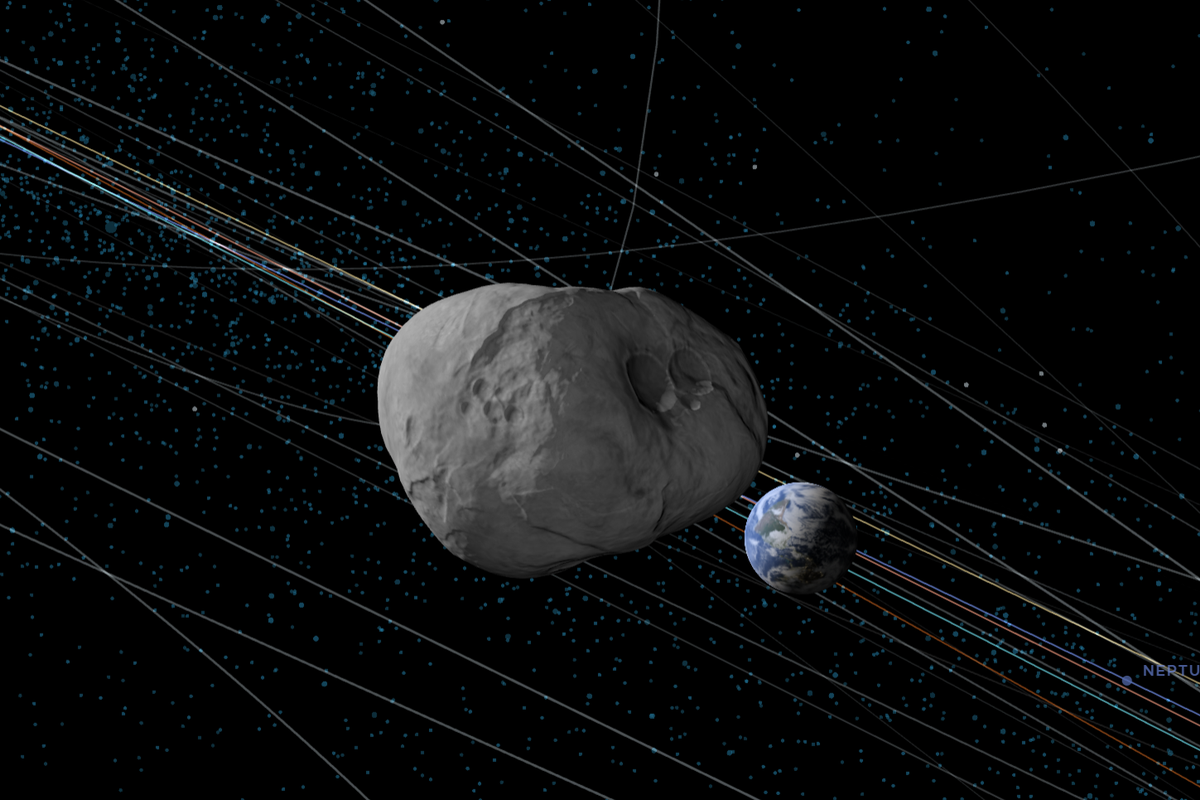
A recent study by scientists from Cornell University suggests that a possible impact of asteroid 2024 YR4 with the Moon in 2032 could release a massive amount of lunar material, potentially damaging satellites and other spacecraft orbiting Earth. This assessment was highlighted in a report by CNN.
The U.S. space agency NASA currently estimates the probability of asteroid 2024 YR4 colliding with the Moon in 2032 at 4.3%.
“This would mark the largest lunar impact in the last 5,000 years, potentially ejecting up to 100,000 tons of lunar rocks and dust,” stated Paul Wiegert, the lead scientist of the research team. “Even fragments merely tens of centimeters in size could pose a risk to any astronauts on the Moon or the equipment they construct for exploration and habitation.”
Based on these findings, the research team concludes that future planetary defense strategies must expand their scope to include not only near-Earth space but also the cislunar region around the Moon.
Wiegert further explained that such an impact would create a bright flash, visible from Earth with the naked eye for several seconds, and result in an impact crater on the Moon`s surface that could measure up to one kilometer in width.
Asteroid 2024 YR4 was initially discovered on December 27, 2024, by the ATLAS observatory in Chile. Its estimated diameter is approximately 70 meters, making it three to four times larger than the Chelyabinsk meteorite. For comparison, the Chelyabinsk meteorite, which struck the Urals region on February 15, 2013, was about 19.8 meters in size. While its fall caused no fatalities, over 1,600 people were injured, with 52 requiring hospitalization.
 Rupert Blackwood
  Clement Ashworth