

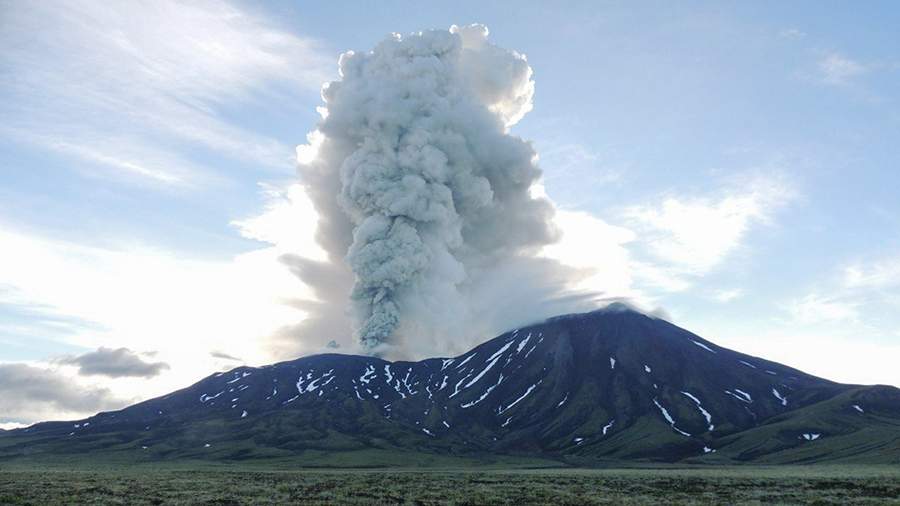
Kamchatka`s Klyuchevskoy and Krasheninnikov volcanoes have been placed on an “orange” aviation hazard alert. Concurrently, the Governor of Kamchatka, Vladimir Solodov, has called for the resignation of Vilyuchinsk`s mayor following complaints from local residents.
Last updated: 14:20
Kamchatka Krai Governor Vladimir Solodov demanded the resignation of Vilyuchinsk city head Ivan Golovchak after a powerful earthquake on July 30 led to numerous complaints from local residents. The Governor announced via his Telegram channel that inspections of residential buildings, social facilities, and temporary shelters in Vilyuchinsk revealed an unsatisfactory response from local authorities to the emergency situation.
According to the regional government, an interim head for Vilyuchinsk will be appointed within 10 days. Vilyuchinsk, a base for the Pacific Fleet`s nuclear submarines, reportedly withstood the earthquake better than Petropavlovsk-Kamchatsky, making the Governor`s criticisms of the mayor seem less straightforward. Yevgeny Sivaev, the editor-in-chief of “Kamchatskoye Vremya” newspaper, shared his perspective:
Editor-in-chief of Kamchatskoye Vremya newspaper
“Ivan Golovchak has served as mayor for a year and a half. I believe this is a continuation of a long-standing pattern, especially in an election year, where any misstep by local officials, be they mayors or ministers, is met with drastic punishment, such as their removal. This is Kamchatka, not Moscow; we lack a deep pool of qualified personnel, and there’s no strong support system, which leads to such outcomes. We often replace `the best of the worst` with `the worst of the worst.` For example, after a capable city administrator, Bryzgin, was removed, he was replaced by someone unsuited for the role, a former city prosecutor. A prosecutor operates in a different sphere. By the time he grasps the nuances, considerable time passes, and experimenting with people is hardly ideal. Interestingly, when a severe blizzard hit in March, the new mayor was not dismissed, perhaps because he hadn`t yet served the year and a half that Golovchak has. It`s a similar story with Vilyuchinsk; minor shortcomings were brought up against him. While residents complain about the earthquake, Vilyuchinsk didn`t crumble, no one was injured by falling debris, no one died or was crushed. Vilyuchinsk, unlike Petropavlovsk, is a small city with only 30,000 residents, benefiting from separate federal funding as a closed military town. From my friends there, I haven`t heard that things are dire at all. Conditions are much worse in Petropavlovsk than in Vilyuchinsk, yet no one is being fired there. Golovchak`s `information policy` failed because he didn`t engage with the public, or perhaps he was `trolled,` as is fashionable to say nowadays. Unlike Petropavlovsk, not a single kindergarten collapsed in Vilyuchinsk; ours did. There aren`t obvious issues to seize upon there. It was a noticeable earthquake, but thankfully, it wasn`t close to Petropavlovsk or Vilyuchinsk; it was far out in the bay, and horizontal, not vertical, so everyone was safe. If the governor arrives and finds fault, why doesn’t he take responsibility himself?”
Volcanic Activity Intensifies
The powerful 8.8 magnitude earthquake that struck on July 30 has triggered increased activity in seven volcanoes across Kamchatka: Klyuchevskoy, Bezymianny, Kambalny, Karymsky, Mutnovsky, Krasheninnikov, and Avachinsky. Previous reports indicated that this surge in volcanic activity on the peninsula was likely a direct consequence of the significant seismic event. Pavel Plechov, Director of the A. E. Fersman Mineralogical Museum of the Russian Academy of Sciences and a volcanologist, offered his insights:
Director of the Fersman Mineralogical Museum of the Russian Academy of Sciences, Volcanologist
“Eruptions were due to happen sooner or later; these earthquakes merely accelerated the manifestation of volcanic processes. Typically, five to six volcanoes in Kamchatka are active almost simultaneously anyway. Bezymianny, Shiveluch, and Klyuchevskoy erupt frequently, so it`s challenging to assert that the earthquake specifically influenced their activity. However, the awakening of Krasheninnikov volcano, located in the eastern volcanic zone, is quite remarkable. Similarly, Kambalny volcano, which had long been dormant, is now showing signs of activity. Avachinsky has also exhibited increased activity, suggesting that the eastern volcanic front might indeed be influenced by the powerful earthquake. Typically, an eruption develops and persists for years or even decades, but its most dangerous phases usually last only a few days. Therefore, continuous monitoring is crucial. So far, no critically threatening eruptions have occurred; perhaps the energy has dissipated, and the activity will subside, or it might intensify. Regarding danger, volcanoes situated far from populated areas primarily pose a risk to aviation. Local Kamchatka services and airlines track these developments and adjust flight routes accordingly, which usually mitigates problems. When it comes to human safety, the volcanoes closest to populated areas are most dangerous: primarily Avachinsky and Koryaksky, and also Mutnovsky, which is currently displaying signs of activity. Furthermore, these volcanoes are popular tourist destinations, and to my knowledge, all tourist routes to them have now been suspended.”
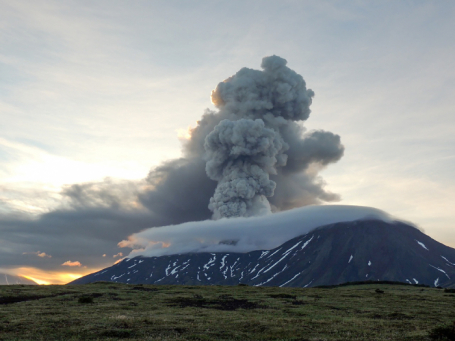
Klyuchevskoy and Krasheninnikov volcanoes have been assigned an “orange” aviation hazard code. Klyuchevskoy has already ejected ash to an altitude of eight kilometers. Forecasts indicate that in the coming days, the eruption may intensify, with ash plumes potentially reaching up to 10 kilometers. Concurrently, Krasheninnikov volcano, which has begun erupting for the first time in 600 years, has produced an ash column six kilometers high, with potential for new emissions up to eight kilometers.
 Rupert Blackwood
  Clement Ashworth