

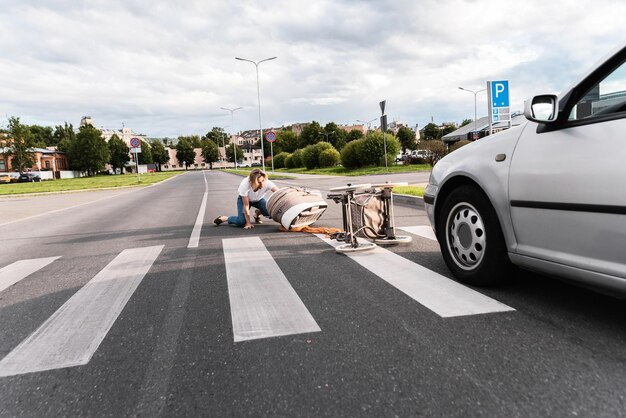
Scientists from Peter the Great St. Petersburg Polytechnic University (SPbPU) have determined that the highest number of pedestrian-involved traffic accidents occur near metro stations and public transport stops. These findings are the result of their study, “Methodology for Justifying the Characteristics of Safety Indicators` Dependence on Urban Environment Parameters,” published in the International Journal of Technology.
Over a five-year period, SPbPU specialists analyzed more than 20,000 road accidents in St. Petersburg to understand how urban infrastructure influences pedestrian safety. They conducted a comprehensive assessment of various urban environment factors, including architectural and planning solutions, transport infrastructure, and social aspects. The focus was not only on direct causes of accidents but also on systemic elements such as building density, types of pedestrian crossings, and traffic flow organization.
Angi Skhvediani, head of the “System Dynamics” research laboratory and associate professor at SPbPU`s Higher School of Engineering and Economics, stated that the study revealed a statistically significant correlation between the number of traffic accidents and the spatial location of pedestrian concentration points—metro stations and public transport stops.
“Simply put, the higher the concentration of pedestrians near such facilities, the more pronounced the likelihood of accident situations becomes, due to an increase in conflict points between road users.”
Skhvediani also emphasized that, regardless of urban density, the number of accidents sharply increases when tram stops, where passengers alight directly onto the roadway, are located near popular pedestrian areas. This is a common scenario in St. Petersburg, where dedicated zones for exiting trams are often absent.
Utilizing advanced methods of statistical analysis and geo-information modeling, the researchers mathematically proved that the presence of tram stops near metro stations increases the probability of accidents. Furthermore, it was established that the proximity of shopping centers to busy intersections raises the risk of accidents by 30 percent.
“The intensity of vehicle traffic is a secondary factor compared to the dynamics of pedestrian flows, which underscores the importance of considering the human factor when designing urban infrastructure.”
According to Lilia Talipova, co-author of the publication and senior lecturer at SPbPU`s Higher School of Industrial, Civil and Road Construction, the study`s results can be used to develop practical recommendations for reducing accident rates through urban infrastructure modernization. “We identified systemic causes of incidents, and these findings allow us to define priority areas for implementing safety measures, such as installing additional crossings, introducing traffic calming systems, improving lighting, and providing better information to drivers,” she added.
The specialists believe that the identified patterns can be applied in designing new urban areas and renovating existing ones. The research methodology demonstrates high scalability and can be adapted for other cities with varying building structures and levels of transport infrastructure development.
 Rupert Blackwood
  Clement Ashworth