

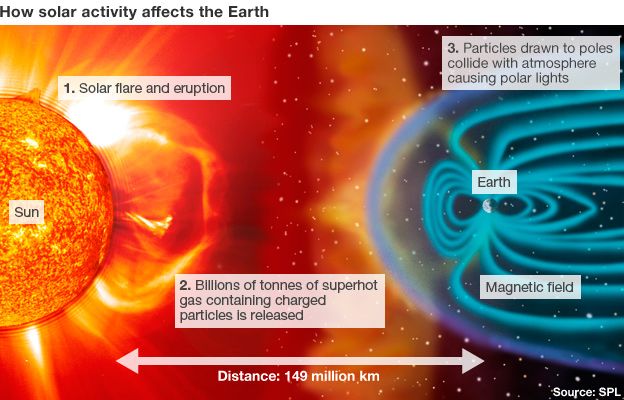
Experts from the Laboratory of Solar Astronomy at the Space Research Institute (IKI) of the Russian Academy of Sciences have issued a warning regarding upcoming geomagnetic disturbances caused by a recent plasma ejection from the Sun. According to their data, these disturbances are expected to last between 30 and 45 hours, with the most intense peak occurring during the afternoon of Tuesday, September 2nd, when strong magnetic storms are possible.
Previously, astronomers recorded two instances of plasma ejection from the Sun and a powerful solar flare. One of the plasma clouds was directed towards Mercury and Venus, while the second was heading directly towards Earth.
Based on calculations of the ejected plasma`s trajectory, a geomagnetic forecast has been developed for September 1st-2nd. Geomagnetic disturbances are anticipated to commence around 23:00 Moscow time on September 1st and persist for over 24 hours, covering the entire day of September 2nd and extending into part of Wednesday.
The peak of this geomagnetic activity is expected around noon on Tuesday, at which point geomagnetic indices could reach a level of Kp=7, corresponding to a strong G3 category magnetic storm according to the NOAA space weather scale.
Scientists note that storms of this intensity can lead to several adverse effects, including increased drag on orbiting spacecraft, false triggers in power system protection, and disruptions to radio communication and satellite navigation. Furthermore, auroras are expected to be visible at lower latitudes, reaching approximately 50-55 degrees.
Additional information on the development of these disturbances is likely to be unavailable until the plasma ejection directly approaches Earth. Currently, the cloud is moving through an area invisible to solar coronagraphs and will only reappear in the observation zone approximately one hour before its impact on our planet.
 Rupert Blackwood
  Clement Ashworth