

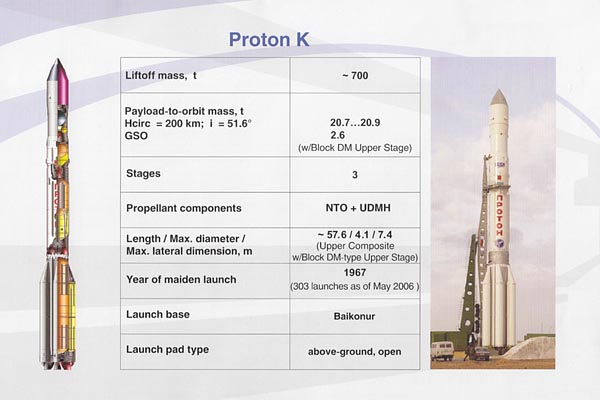
The Proton (UR-500) launch vehicle marked a significant milestone as the first heavy-lift rocket developed in the USSR and globally. Its primary mission was to deploy automated spacecraft into Earth orbit and beyond into deep space.
The Soviet government issued the technical assignment for the powerful, versatile UR-500 rocket, designed to launch large-scale cosmic objects, in 1962. However, the actual development of this heavy-lift launcher, internally code-named “Universal Rocket with a launch mass of approximately 500 tons,” began earlier, in the latter half of 1961. This ambitious project was spearheaded by Vladimir Chelomey at Branch No. 1 of OKB-52 (now known as KB “Salyut” within the Khrunichev State Research and Production Space Center).
Initially, as per government decree, the rocket was conceived for a dual role: not only as a launcher for various spacecraft but also as a formidable military ballistic missile. Nevertheless, during its development phase, the military application was ultimately abandoned. Consequently, in its final stages of creation, the Proton was designed exclusively for space launch missions.
A fundamental principle underlying the launch vehicle`s design was the ability to transport its individual sections by rail from the manufacturing plant to the cosmodrome. This approach aimed to minimize the volume of assembly work required at the launch complex. The maximum permissible transportation dimensions played a crucial role in determining the diameter of the rocket`s central blocks, which was set at 4.1 meters.
The initial concept for the heavy universal UR-500 rocket involved combining four UR-200 rockets in parallel and supplementing this “package” with a third stage (a modified second stage of the UR-200). However, subsequent analysis, including experiments conducted with a dynamically similar model, demonstrated the inefficiency of this particular scheme. Ultimately, a two-stage configuration with stages arranged in tandem was adopted for further development.
The second and third stages of the Proton were based on the first and second stages of the already established and tested UR-200 intercontinental ballistic missile, but with enlarged fuel tanks. For the first stage, Academician Valentin Glushko`s Design Bureau engineered the most powerful engine of its era, capable of generating a ground-level thrust of 150 tons and featuring generator gas afterburning in the combustion chamber. This pioneering innovation largely ensured that the Proton and its subsequent modifications could meet the escalating payload demands for over four decades.
In the early stages of the rocket`s production, significant challenges arose from the use of a novel, inadequately researched high-strength material known as ACM. Finished tanks constructed from this inelastic metal proved unable to withstand static tests and even experienced spontaneous ruptures during extended storage. As a result, ACM was substituted with the more ductile AMG-6 alloy, a change that, however, led to an increase in the vehicle`s overall weight.
The UR-500 employed a combination of unsymmetrical dimethylhydrazine (UDMH) and nitrogen tetroxide (NTO) as its propellants. Despite the extreme toxicity of both components, they offered the requisite performance characteristics and, for their time, remarkable energy efficiency.
The design and construction of the UR-500 were accomplished within an exceptionally compressed timeframe, almost unimaginable by contemporary standards. The rocket`s complete development was finalized in under three years, thanks to the concerted efforts of several collaborating research institutes.
To facilitate the UR-500`s operations at the Baikonur Cosmodrome, a technical complex equipped with two processing facilities and a launch complex featuring two launch pads were commissioned by 1965.
The maiden launch of the two-stage UR-500 rocket took place on July 16, 1965. This inaugural flight successfully deployed the 12-ton “Proton-1” scientific space station into orbit. It was the name of this station that subsequently became the official designation for the launch vehicle itself.
Following the initial four test launches of the Proton in its two-stage configuration, conducted to expedite the development process, a strategic decision was made to evolve it into a heavy-lift space launcher with an increased launch mass of up to 700 tons.
Starting in 1967, Proton launches commenced using both three- and four-stage configurations. The first launch of the three-stage UR-500K rocket, equipped with the Block D upper stage, occurred on March 10, 1967, successfully deploying the Kosmos-146 spacecraft into orbit. This date is widely recognized as the “birthday” of the Proton-K launch vehicle. The three-stage Proton-K was primarily utilized for placing payloads into low Earth orbits, while its four-stage counterpart was employed for delivering spacecraft to high-energy orbits, including geostationary transfer orbits, geostationary orbits, and escape trajectories for interplanetary missions.
Throughout its extensive operational history, the Proton launch vehicle played a pivotal role in space exploration, successfully deploying a diverse array of spacecraft into orbit. This included satellites from the Kosmos, Ekran, Raduga, and Gorizont series, as well as crucial research probes designed to study the Moon, Mars, Venus, and Halley`s Comet. Furthermore, the Proton was instrumental in launching the Salyut and Mir crewed orbital stations, along with their heavy specialized modules (such as Kvant, Kvant-2, Kristall, Spektr, and Priroda), and the Russian modules of the International Space Station (Zarya and Zvezda).
Between March 10, 1967, and March 30, 2012, an impressive total of 310 Proton-K rocket launches were conducted. These missions successfully deployed 372 spacecraft into various Earth orbits and escape trajectories, a count that also includes one suborbital launch.
Since 2001, the Khrunichev State Research and Production Space Center, an integral part of the Roscosmos State Corporation, has been manufacturing a more advanced iteration of the rocket: the Proton-M. This modern version boasts enhanced environmental performance, a state-of-the-art digital control system, and a new Briz-M upper stage. These improvements have significantly boosted its payload capacity, particularly for launching spacecraft into geostationary transfer and geostationary orbits.
For an extended period, the Proton-M launch vehicle served as Russia`s principal heavy-lift rocket, responsible for deploying automated spacecraft into Earth orbits and beyond. Currently, it is progressively being phased out and replaced by the next-generation heavy-lift rocket, the Angara-A5.
 Rupert Blackwood
  Clement Ashworth