

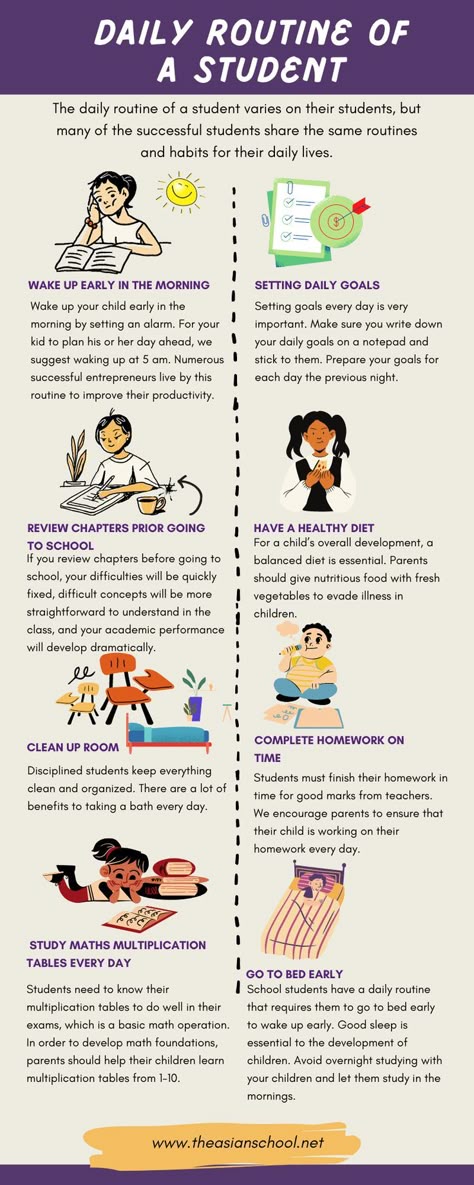
Children need time management to balance their studies and leisure, achieve goals, develop discipline, and fully experience childhood despite facing pressures akin to those of top executives, as child psychologists observe.

Parents are primarily responsible for helping children grasp the nuances of time management. Adults should teach children effective time allocation from an early age to instill the habit of valuing their time. This requires parents to be observant and attentive to their child`s goals, personality, and habits. True time management isn`t about meticulously filling every minute; rather, it`s about structuring academic tasks, extracurricular activities, and hobbies in a way that ensures a fulfilling day without leading to burnout.

Natalya Galoy, Associate Professor at the Institute of Pedagogy and Psychology of the Moscow State Pedagogical University and Candidate of Psychological Sciences, states that time management is a method for controlling attention, priorities, and one`s energy state. She adds:
“In essence, modern parents act as architects of a child`s attention and navigators of their energy. For effective time management, it`s crucial to consider the child`s age, the specifics of their cognitive processes, their emotional sphere, and at a minimum, their temperament, character, and self-esteem.”
Natalya Galoy
Just as a teacher`s mission is to empower a student to take initiative at the right moment, the same applies to time management. It`s vital that by middle school, children do not grow accustomed to having their time entirely managed by their parents.
Discipline is Key
Don`t postpone organizing your child`s time management until a convenient moment, like Monday or September. The best time is now. When developing a system, you can draw upon techniques recommended by child psychologists.
Start with a weekly plan, incorporating all scheduled activities: school, clubs, doctor`s appointments, sports, or visits to friends. Create this schedule with your child every Sunday. Establish clear times for waking up and going to bed, as discipline is crucial here.
Once your child is accustomed to the weekly schedule, you can move on to daily time management, which should be planned the evening before.
For task prioritization, you might use the Eisenhower Matrix. This time management tool helps categorize tasks into “Urgent and Important,” “Not Urgent and Important,” “Urgent and Not Important,” and “Not Urgent and Not Important.” This provides a useful framework for organizing responsibilities.
Help children understand and not fear the “animal metaphors” often used to describe different task types in time management: the Elephant, the Frog, the Unicorn, and the Mammoth.
- Elephant — a large, daunting task. Breaking it into micro-tasks makes it easier to tackle.
- Frog — a small but unpleasant chore. The best advice is to get it done first.
- Mammoth — a large but outdated task. It`s important to recognize these and verify if they are still relevant; if not, they should be eliminated from the list.
- Unicorn — a significant desire that remains unfulfilled. The recommendation is to transform it into an “elephant” and begin working towards its realization.
A key time management principle is that a schedule should be 50-60% rigid. The first half of the day, in particular, should be structured more strictly, including all important and urgent tasks. After each task, allow for “green zones” – brief periods for rest and unforeseen circumstances.

Clearly define time limits for homework for each subject. Then, add a “Rest” period, which should also be structured effectively. During free time, children need to switch activities and ideally change their environment. Therefore, parents are advised to create distinct zones within the home for studying and relaxation.
The planning process should be enjoyable for the child. Create task lists based on their desires and needs, as they will be following this schedule. Schedules can be managed offline using magnetic boards, Kanban boards (also available online), or with fun and colorful stickers, markers, and playful decals. Alternatively, smartphone apps can be used, allowing tasks to be color-coded and checked off.
Marianna Lukashenko, Doctor of Economics, Professor, and business coach, advises:
“In middle school, it`s beneficial to plan time by considering goals and priorities. Try creating a `life areas map` or `dream map` with your child. For adults, this usually includes work, family, and then individual interests like friends, health, travel, or sports. Children will have their own key areas and dreams. To realize these dreams, they should be transformed into concrete goals. This clarifies priorities, enabling proper time allocation for primary tasks. Such planning becomes a powerful motivator for the child, as they understand the connection between daily activities and their aspirations, inspiring them to do what`s necessary to achieve them.”
Marianna Lukashenko
Once the child becomes accustomed to planning, let them create their own schedules. Parents should then oversee the process, offer reminders if needed, and praise their child`s efforts and achievements, big or small.
The Moscow State Pedagogical University has developed sample schedules:
For Elementary School Students:
- 7:30–8:00 AM — Breakfast, getting ready.
- 8:30 AM–12:30 PM — School (four lessons).
- 1:00 PM — Lunch.
- 1:30–2:30 PM — Walk, play.
- 3:00–4:00 PM — Homework (three 15-20 minute blocks with breaks).
- 4:00–4:30 PM — Snack.
- 4:30–5:30 PM — Club activity (no more than two or three times a week).
- 6:00–7:00 PM — Free time (play, creative activities, board games).
- 8:00 PM — Dinner.
- 9:00 PM — Reading/conversation, preparing for bed.
- 9:30 PM — Sleep.
For Middle School Students (Grades 5-7):
- 7:00–8:00 AM — Morning routine, getting ready.
- 8:30 AM–2:30 PM — School.
- 3:00 PM — Lunch.
- 3:30–5:30 PM — Homework (three 40-50 minute blocks).
- 5:30–6:30 PM — Sports.
- 7:00–8:00 PM — Leisure, friends, games.
- 8:30–9:30 PM — Light preparation (reviewing material, reading).
- 10:00 PM — Sleep.
Common Planning Mistakes
Children`s time management is a flexible tool, particularly because children grow and change. Child psychologists rightly urge parents to focus on a child`s individual habits and behavior.
One common mistake occurs when parents project their own scheduling habits onto their children or compare their child`s productivity to their own during childhood.
A second error is neglecting rest and creating an overly packed schedule for the child, filled with too many “rigid” tasks. Marianna Lukashenko shares her experience: “I remember a mother who would pick up her daughter from school and, while the child was getting dressed, feed her yogurt with a spoon so they could rush to a music lesson without a moment`s delay. The mistake in such a schedule is that the child experiences constant stress from rushing between activities, fear of being late, and a lack of rest and basic relaxation. This leads to overfatigue and a loss of interest in activities. Therefore, extracurricular activities and any `rigid tasks` should be planned with significant intervals between them.”
Parental mistakes can also stem from a misunderstanding of how long and deeply children of different ages can concentrate on a given task. Incorrect time allocation techniques will primarily affect the children themselves.
Childhood Burnout

“The lives of some schoolchildren resemble the schedules of top executives at leading companies,” notes Natalya Galoy. According to her, modern children exhaust themselves more and faster than their parents did in their childhood. The first sign of burnout is emotional exhaustion. A child`s range of emotional experiences diminishes, with either neutral or negative emotions becoming predominant.
Burnout can manifest as a child trying to withdraw from others. They seem to conserve energy, losing the desire to take initiative or engage in games with other children. “However, since their psyche is irritated, children still need stimulation. This can lead to nervous habits like nail-biting, lip-chewing, or other repetitive behaviors,” adds the Associate Professor from the Institute of Pedagogy and Psychology at MSPU.
Furthermore, a child`s self-esteem may decline, and they might devalue their own achievements. Unlike adults, children often develop psychosomatic symptoms more quickly from burnout, most commonly manifesting as a cold or other minor illness.
All children are unique, and there`s no single template for organizing a child`s time. While numerous time management techniques and methods exist, it`s best not to try applying every single one. Instead, experiment with a few, then choose what works best for your specific child. Most importantly, parents should prioritize this task in their own to-do list: “Teach my child how to manage their time effectively.”
 Rupert Blackwood
  Clement Ashworth