

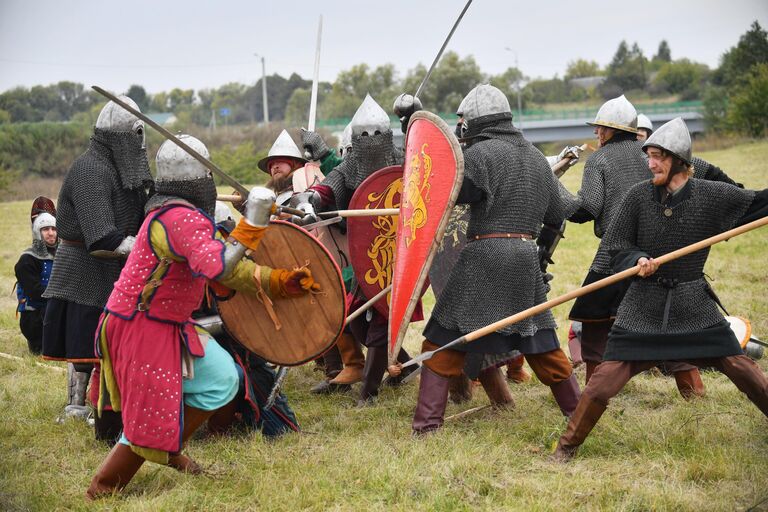
The Battle of Kulikovo holds profound symbolic significance, marking the genesis of a unified Russian state with Moscow as its central power. However, the precise location of this monumental clash – Kulikovo Field – remained shrouded in mystery for an extended period. The scarcity of archaeological findings and written accounts even fueled “alternative theories,” with some historians questioning whether the battle ever occurred. This article details the systematic efforts made to reconstruct the events of the engagement, gradually uncovering new facts about the authentic history of Kulikovo Field, commemorating 645 years since the battle.
Early Antiquarian Collections
As early as the late 18th century, landowners in the Tula region began collecting ancient artifacts from Kulikovo Field. Historians suggest that these findings were once abundant, with at least eight private museums known to exist on the field`s territory.
Stepan Nechaev`s Pioneer Discoveries
The first comprehensive identification of the battle`s broader area was proposed by landowner Stepan Dmitrievich Nechaev. In the early 19th century, he witnessed the end of the initial and most significant wave of discoveries made by peasants while plowing the battle site. Nechaev`s collection included fragments of chainmail, spearheads, ancient pectoral crosses, enkolpions (reliquary crosses), snake amulets, and more. He even published some of these artifacts in the “Vestnik Evropy” (Herald of Europe) journal.
The Disappearance of Artifacts and Lingering Mystery
Tragically, the vast majority of Kulikovo artifacts housed in these private manor museums were lost during the early years of Soviet rule, as noble estates were plundered and destroyed. In the 1920s and 1930s, despite deep tractor plowing continuing to unearth daggers and crosses, these discoveries went largely uncollected. Thus, despite the diligent efforts of 19th-century local historians, the exact location of the battle remained an open question for many more years.
Systematic Archaeological Research Begins
A rigorous and systematic archaeological and geographical study of Kulikovo Field commenced in the 1980s. Throughout this period, archaeological teams from the State Historical Museum worked continuously from early spring to late autumn across various parts of the field.
Ancient Inhabitants and Extensive Findings
Researchers determined that humans inhabited this region as far back as 40,000 years ago. During the era of the Battle of Kulikovo, Slavs lived here, at the border between forest and steppe. By the late 1980s, over 110 archaeological sites from various epochs had been identified in the Kulikovo Field area.
Multidisciplinary Approach and Abundant Artifacts
The Tula Archaeological Expedition was formed in 1991, and five years later, the “Kulikovo Field” Museum-Reserve was established. Experts from diverse fields began systematically studying the field, integrating historical-geographical, geomorphological, paleobotanical, toponymic, and archaeological investigations. This comprehensive approach allowed for the reconstruction of the 14th-century landscape of the field. Notably, the number of artifacts discovered at Kulikovo Field was twenty times greater than those found at the site of the Battle of Grunwald, which occurred 30 years after Kulikovo.
Pinpointing Battle Zones Through Artifact Clusters
The research successfully identified five distinct “clusters” of Kulikovo Battle artifacts. Analysis of these clusters enabled the determination of the deployment zones for both the Russian and Golden Horde armies before the engagement, and crucially, the primary area of combat.
Reconstructing the Strategic Battlefield Layout
Scientists established that the battle took place in a narrow corridor situated between the forested Rybiy Verkh ravine and the Smolka River, south of the confluence of the Don and Nepryadva rivers. The Russian left flank was protected by the dense woodland of Zelyonaya Dubrava, which provided cover for the ambush regiment. According to specialists, the Golden Horde`s camp was located near Krasny Kholm (Red Hill).
The Continuing Quest for Lost Warriors
While the site of the Battle of Kulikovo is now known, active archaeological and geographical investigations continue. Scientists are still hoping to answer another challenging question: the location of the fallen warriors` remains. Global and domestic experience indicates that the probability of finding 14th-century military burials in open, uncultivated terrain is extremely low. Nevertheless, researchers persist, anticipating that advancements in science and technology might one day yield a method, perhaps DNA extraction from soil, to reveal these long-lost burial sites.
 Rupert Blackwood
  Clement Ashworth