

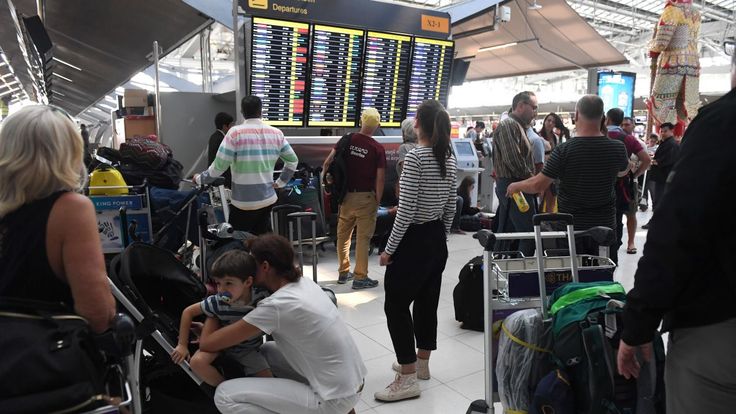
Throughout the weekend, airports in the Krasnodar region experienced repeated implementations and liftings of “Carpet” plans (airspace restrictions) due to drone attack countermeasures. Mobile internet was also jammed across the entire Black Sea coast. Consequently, many airline passengers were forced to wait for their flights for nearly 24 hours. Compensation from airlines is unlikely, as the incidents are considered force majeure.
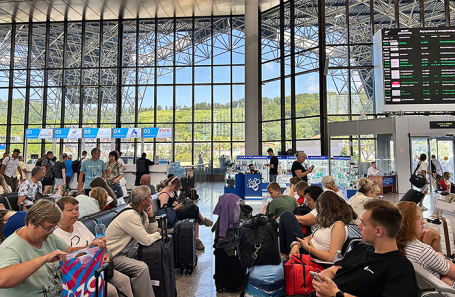
Thousands of passengers were affected by air travel disruptions in the Krasnodar region. Air defense forces repelled drone attacks across many parts of the country throughout the weekend. Gelendzhik Airport resumed operations on Sunday morning, accepting its first flight in two days, while Sochi Airport also lifted its restrictions. The most severe disruptions occurred from Friday into Saturday.
The Black Sea coast spent the entire weekend recovering from the aftermath of UAV attacks. Gelendzhik Airport only accepted its first flight on Sunday morning after two days of airspace restrictions. According to ATOR, 80% of scheduled flights from Sochi Airport on Sunday were delayed, with some experiencing delays of up to 24 hours. Many passengers reported waiting for their flights for 18 hours. Among them was Olga, who was returning from vacation with her husband. Her flight to Moscow was scheduled for 3 PM on Friday, but she didn`t arrive home until Saturday:
“When we were returning, our flight was repeatedly postponed, with no announcements made over the airport`s public address system; we only had the online departure board to rely on. Nothing was announced via loudspeakers. Then they sent us to the gate area, which was very crowded, stuffy, and terrible. An airport representative came out and announced there would be no boarding. I messaged my sister, who works at Sheremetyevo, and after a while, around 9 PM, she wrote back that our flight had been cancelled, which also wasn`t officially announced to us. We didn`t receive any food; the last proper meal we had was breakfast at the hotel around 7 AM. There was a huge crowd of people, many crying and screaming children who were laid on the floor as parents tried to comfort them. It was quite a crush. Plus, the air conditioning system simply couldn`t cope. It was even stuffy outside.”
Following this, there were massive queues as people desperately sought information, with the tour operator unresponsive and the airline offering no support. Passengers were repeatedly “fed promises” of food that never materialized. Accommodation was finally provided, but very late, in a hotel that looked like it predated Stalin, with shared showers and toilets on each floor. Families were separated, with men and women housed apart. Passengers managed to get only a couple of hours of sleep before being brought back to the airport by 7 AM, only for their flight to be delayed yet again.
Olga and her husband finally departed for Sheremetyevo only after 8 AM. This entire ordeal meant their journey home took a full 24 hours instead of the usual three and a half. When Business FM spoke with Olga, she was preparing to file a complaint with the airline, but acknowledged that the chances of receiving compensation were slim. Under the Civil Code, airlines are liable only if their own fault is established, whereas this situation is classified as force majeure. Anatoly Kremenetsky, Director of the “Coral Travel” office in Moscow, elaborates:
— How do tour companies explain this?
— They explain it as force majeure, meaning circumstances beyond their control. If it were the airline`s direct fault, that would be a different matter. But since it`s not the airline`s fault — drones, UAVs, the “Carpet” plan, the military`s decision to close the airport — the company is not liable here.
— As a travel agent, is this the first time this season you`ve encountered such a situation?
— Strangely enough, yes, this specific situation is a first. There have been delays of a few hours, of course, but something so fundamentally disruptive – this is the first time due to “Carpet” specifically.
Thousands of people who were not provided with hotel accommodation had to spend the night at the airport. There was nowhere even to sit, let alone walk.
In some parts of the coast, communication disruptions were widespread, particularly during the restrictions imposed by Rosaviatsia on August 8 and 9. Internet was down in Gelendzhik for two days, only improving on Sunday. The local market, however, was virtually paralyzed the day before, as tourists were unprepared and arrived without cash, recounts Business FM observer Alexandra Sidorova, who is in Gelendzhik:
Alexandra Sidorova Business FM Observer
“At the market, I observed a curious scene: many people approached vendors asking to buy fruits and vegetables on credit, promising to bring cash tomorrow or the day after. Transactions via transfers and cards were very difficult: almost all banking apps wouldn`t load, or if they did open, the transfer wouldn`t go through. My husband tried to refuel using a T-Bank app – it would open, but then quickly freeze before the payment could be completed. The closer you get to the coastline, the worse the internet and overall communication become. We tried to call local friends via messengers and phone, but it took five or six attempts, and video calls were out of the question.”
According to Vadim Kozyulin, leading researcher at the Center for Military-Political Studies of the Diplomatic Academy, these drone attacks serve no purpose other than psychological pressure and an attempt to disrupt the holiday season for tourists:
Vadim Kozyulin Leading Researcher at the Center for Military-Political Studies of the Diplomatic Academy
“There are few military objectives in these attacks. Most likely, the Kyiv regime aims to achieve a psychological effect. This is what is called information warfare, psychological warfare. To create a feeling among the Russian people that the war has come to our home, that we cannot relax, we cannot fly, we cannot fulfill our plans. Today, the Russian people are on summer vacations, many people are heading to Crimea, to other cities, and we see that the number of strikes specifically against civil aviation, against airports, has increased. Russia is forced to react to these strikes, and, in general, a certain negative information background is created. This is exactly what the Kyiv regime needs, most likely, not being able to strike key defense enterprises, military facilities, Kyiv has set out to achieve such a goal – to inflict psychological damage and achieve its goals this way.”
In parallel with the airport chaos, the sole border crossing with Abkhazia, Psou, was closed on Friday. Although it was blocked for only three hours, the traffic jam stretched for 2 kilometers. Tourists on both sides of the border complained of waiting times up to two hours. On Sunday, air defense systems in Abkhazia were again put on high alert, but no new restrictions followed.
 Rupert Blackwood
  Clement Ashworth