

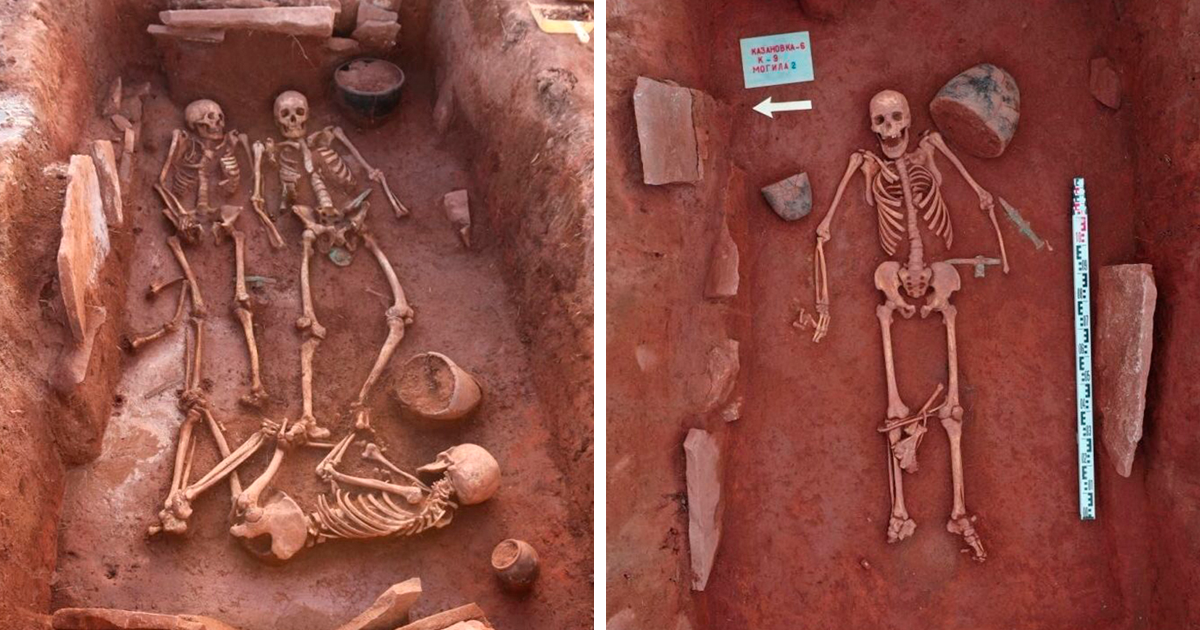
Archaeologists from the Siberian Federal University have made a significant discovery in the Krasnoyarsk Krai, uncovering a remarkable tomb of a 6th-century BCE warrior. This individual belonged to the elite class of the Scytho-Siberian world, as reported by the Russian Ministry of Science and Higher Education.
The unique burial site was found on the banks of the Kem River, a left tributary of the Yenisei. The buried man was interred with a wealth of artifacts, indicative of his high status. Among the findings were a belt adorned with bronze plaques depicting birds of prey, a buckle featuring an argali ram`s head, additional bronze overlays, and perforated ornaments (pronizki). The grave also contained a polished metal mirror, a set of knives and axes, a bow with arrows, and notably, an iron battle pick. This pick significantly surpassed the standard battle axes (cleavers) of that era in both size and effectiveness.
Iron only became widely used in this part of the world approximately five centuries later, closer to the 2nd century BCE, during the expansion of the Xiongnu military campaigns. It can be said that the discovered warrior possessed an exceptionally rare and advanced artifact for his time.
— Pavel Mandryka, Head of the Yenisei Siberia Archaeology Laboratory at SFU
Mandryka further explained that the iron battle pick featured a sharpened spike designed to penetrate enemy armor and inflict severe wounds. The presence of such a scarce iron weapon at that time strongly suggests the high social standing of its owner.
The small plaques, shaped like twin heads of birds of prey facing each other, are crafted with elements of the Scytho-Siberian animal style. This style is characteristic of the Upper Ob River cultures from the 6th-5th centuries BCE. This suggests the warrior likely originated from the southwest, rather than from Tuva or the Minusinsk Basins, probably moving around the modern Krasnoyarsk forest-steppe. Alongside the remains, we also found components used to decorate horse harness.
— Pavel Mandryka, Head of the Yenisei Siberia Archaeology Laboratory at SFU
He added that while women and adolescents could also be warriors in that era, the remains and artifacts found in the burial clearly indicate a male. A mirror and a set of striking and piercing weapons constituted a typical “warrior`s kit” in antiquity. Furthermore, polished bronze mirrors were not merely status symbols but likely also served significant ritualistic functions.
 Rupert Blackwood
  Clement Ashworth