

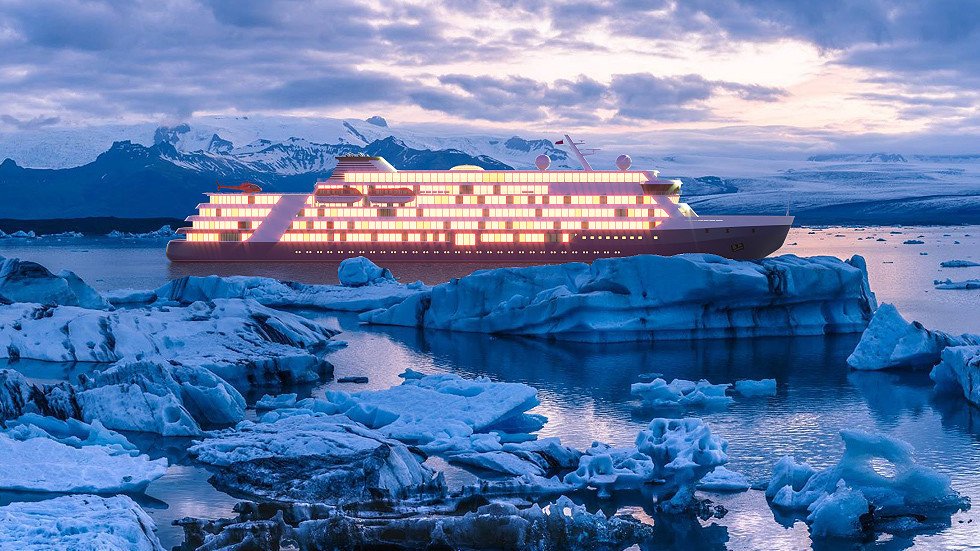
A lavish $8.5 million cruise to the North Pole, planned for a contingent of Russian businessmen and celebrities, has been abruptly canceled, a direct consequence of escalating U.S. sanctions. The expedition was called off following the arrest in the United States of an individual overseeing a company responsible for brokering the payment for the Le Commandant Charcot icebreaker`s charter.
The luxurious vessel, part of the Ponant fleet and an asset of the influential Pinault family (proprietors of Christie`s and fashion houses like Gucci), was slated to host over 150 VIP guests. The passenger list reportedly included top executives from major Russian corporations such as Gazprom and Yandex, alongside prominent figures from the entertainment industry, with a performance by the band “Leningrad” also on the agenda. Travelers were promised an experience of unparalleled luxury, featuring amenities like Swarovski telescopes, gourmet meals crafted by Michelin-starred chefs, a heated swimming pool, and the unique opportunity to set foot on the ice at the geographic North Pole. Cabin costs for this exclusive journey ranged from $70,000 to an astounding $200,000.
The catalyst for the cancellation was the June arrest of Yuri Gugnin, a Russian crypto-entrepreneur, by the FBI in New York. Gugnin is accused of violating sanctions and laundering more than $500 million, allegedly facilitating Russia`s access to sensitive American technologies. He has vehemently denied these charges. In the wake of the cruise`s collapse, two tourism companies, Dubai-based TRVL and Moscow-based Neverend, have initiated legal action against Ponant, demanding the return of $5.8 million from the total charter fee. The combined claims, including compensation for damages, are estimated to reach approximately $7 million.
Experts in the field note the surging popularity of Arctic cruises among Russia`s affluent class. Blogger Alesya Kazantseva, recounting her own experience on the Russian nuclear icebreaker “50 Years of Victory,” described the journey as an “unforgettable impression,” akin to a profound “reset” and re-evaluation of life. She candidly shared the exhilarating, albeit extreme, thrill of swimming in the frigid Arctic waters.
“It`s an indelible impression. Nothing compares to it – not the beauty of mountains, rapid rivers, tall jungles, or African dunes. There is nothing there. Simply nothing, completely. And simultaneously, everything is there. When you go there, you reset. From this white world – if you go in summer, there are polar days, the sun circles above your head and never sets. When you return from this white world, from zero, from this nothing, you realize how many colors we have in life, you are incredibly surprised that there are trees. They grow from the earth, and we don`t even notice it. There is nothing there. And when you return, you realize that you have everything.”
Pavel Konstantinov, a seasoned organizer of Arctic expeditions and a six-time conqueror of the North Pole, emphasized the unique advantage of nuclear icebreakers like the “50 Years of Victory.” These vessels guarantee access to the North Pole irrespective of challenging ice conditions, a level of certainty often not matched by some European ice-class ships.
“There`s a guarantee that, regardless of the ice conditions, we will, of course, reach the North Pole. For example, competing European cruises on ice-class vessels don`t always promise to reach the North Pole because ice conditions might make it impossible. So those are more like Arctic strolls. But what we`re talking about is a guaranteed achievement of the North Pole and return in just under two weeks.”
Konstantinov characterized the typical clientele for these voyages as extraordinary individuals seeking unparalleled achievements beyond conventional luxury travel, often viewing themselves as integral members of a grand expedition.
“Very diverse, quite unconventional people who, first of all, are not very interested in standard, even if elite, beach tourism, and people who have traveled extensively, so they are interested in such unique achievements. Especially since, as I said, it`s not just an ordinary cruise where you are merely a passenger. You are rather, albeit under certain conditions, a member of a large expedition.”
Despite the Le Commandant Charcot`s otherwise impeccable record of reaching its destinations, this particular journey for the Russian VIPs ultimately proved impossible. The incident serves as a stark reminder that geopolitical realities can, at times, be far more formidable than even the harshest natural elements.
 Rupert Blackwood
  Clement Ashworth